
When Unwanted Thoughts Start to Take Over
Many of my clients describe having scary, upsetting, or intrusive thoughts and images that seem to come out of nowhere. You may find yourself questioning what these thoughts mean, replaying situations in your mind, or looking for reassurance that you haven’t done something wrong. Over time, these thoughts can take up more and more of your attention, making it difficult to focus on the things that matter to you.
Understanding OCD and Intrusive Thoughts
Intrusive thoughts are unwanted thoughts, images, or urges that can feel disturbing or completely out of character. Having a thought does not mean you want it, believe it, or that it will happen. In fact, people with OCD are often deeply distressed by the thoughts because they conflict with their values or what is important to them. The more we try to push these thoughts away, analyze them, or find certainty about what they mean, the more attention they can demand.
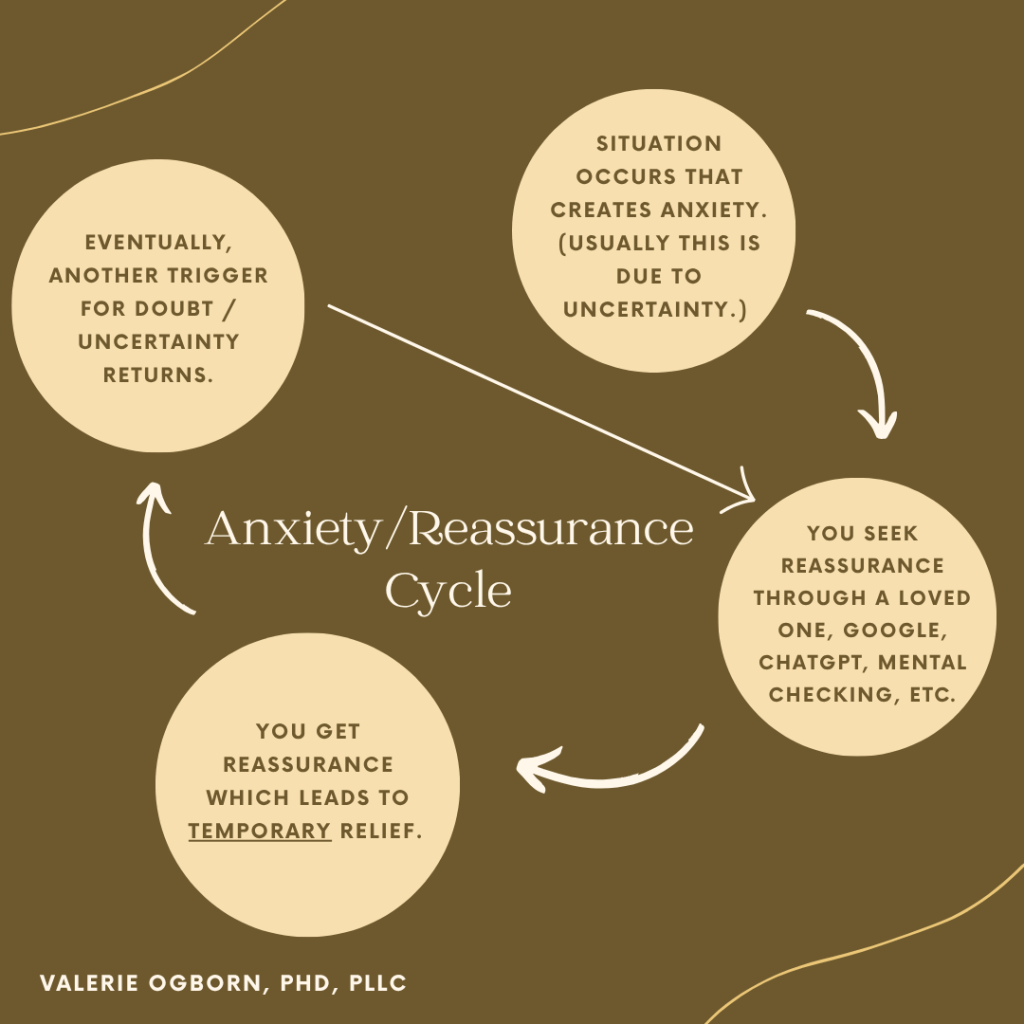
The Anxiety and Reassurance Cycle in OCD
How OCD Therapy Can Help
OCD therapy can help you understand the cycle that keeps unwanted thoughts and compulsions going and learn new ways of responding to them.
Depending on your needs, I may use approaches such as Exposure and Response Prevention (ERP), or Inference-Based CBT (I-CBT).
Together, we can work on becoming less caught up in intrusive thoughts, reducing compulsive behaviors and reassurance-seeking, and building greater comfort with uncertainty. The goal isn’t to make sure you never have an intrusive thought again, but to help you feel less controlled by OCD when those thoughts show up.
Exposure and Response Prevention (ERP) for OCD
I provide structured, evidence-based treatment for OCD. OCD can include intrusive thoughts, mental compulsions, checking, reassurance-seeking, or avoidance that significantly interfere with daily life. I utilize the gold standard approach, Exposure and Response Prevention (ERP), to treat OCD.
ERP involves gradually facing situations, thoughts, or feelings that trigger OCD while learning not to rely on compulsions or other behaviors to make the anxiety go away.
ERP treatment focuses on:
- Understanding the OCD cycle including how obsessions and compulsions strengthen one another
- Reducing compulsive behaviors and obsessive thoughts
- Changing your relationship to intrusive thoughts
- Building confidence and psychological flexibility
Inference-Based CBT (I-CBT) for OCD
Sometimes, I like to incorporate Inference-Based CBT (I-CBT) for treatment of OCD along with ERP or instead of ERP if my clients are not ready or wanting to engage in exposures.
I-CBT treatment focuses on:
- Examines how OCD shifts attention from what is actually known or perceived to imagined possibilities and hypothetical scenarios.
- Helps clients recognize inferential confusion—the tendency to treat something that could theoretically be true as though it is probably true.
- Builds confidence in reality-based reasoning rather than continually investigating or trying to achieve certainty.
- Ultimately, reducing obsessions and compulsions and weakening the OCD cycle
OCD Symptoms & Themes We Might Work on Together
- Intrusive thoughts
- Excessive checking
- Reassurance seeking
- Mental compulsions
- Contamination fears
- Relationship OCD
- Health-related OCD
- Harm OCD
- Sexual or religious intrusive thoughts
- Perfectionism and “just right” experiences
Frequently Asked Questions About OCD Therapy
- Are intrusive thoughts a sign that I actually want to do something?
- No. Having an intrusive thought does not mean you want to act on it, and a thought is not the same as an intention or action.
- Unfortunately, trying to get absolute certainty about what a thought means can become part of the OCD cycle. In therapy, we can work on recognizing intrusive thoughts without giving them more meaning or importance than they deserve, and gradually become more comfortable with uncertainty.
- The goal isn’t to make sure you’ll never have an unwanted thought again. It’s to help you feel less controlled by the thoughts when they do show up.
- How long does OCD therapy take?
- Typically between 12-20 sessions. However, this can vary between clients as everyone is unique.
Want to Learn More?
You don’t need to know exactly what you want to work on when you set up a consultation, we can simply chat about what is bothering you right now and whether my practice may be a good fit for your needs.

